--------------------------------------------------------------------------------------------
Blog Home Shop now! About Media Showcase Links
--------------------------------------------------------------------------------------------

Sunday, March 18, 2012

Gallery: Process: Recycled Glass Beads Workshop

Beads made from recylced glass are one of our most popular bead items. Their colour and form invite touch and as each bead is individually made, each is unique. How they are made is documented below.


First moulds of different sizes are made. To see how the moulds are made see the Powder Glass Beads Workshop page.   


Recycled glass is crushed by hand. Unlike with powder glass beads, dyes and colours cannot be added so the glass used must be the right colour for the resulting bead.   


The resulting crushed glass mixture is called "fritt". For recylced glass beads the glass does not have to be crushed to a fine powder. Some larger pieces can be left as they melt down during the baking process.       


The fritt is then used to fill the moulds. As with powder glass beads the moulds are coated with a fine mixture of kaolin clay and water before being filled to prevent sticking.   


A tray of moulds for a larger sized bead filled with fritt.   


The moulds are put into a kiln to be baked. The kiln has to be hot enough to melt down the lumps of glass in the fritt.   


From experience the bead makers know the right temperature and how long to leave the moulds in the kiln to achieve the right degree of melting.   


When the right temperature has been reached the beadmaker takes out the mould. He uses two awls - one to hold down the mould and the other to shape bead.   
        
He spins the gather of glass round to shape it and then flips it over to shape the other side.   


Here you can see the hole made by one of the awls... this is skilled work which has to be done quickly before the glass cools.  


The finished results. Beads made from recycled glass in blue tones...


     ... and in earth tones. These beads and others made from recycled glass are available on eShopAfrica.com   


Sunday, March 4, 2012

Ahene Pa Nkasa New Line

eShopAfrica.com is pround to present the 2012 line of designer jewellery from Ahene Pa Nkasa. This jewellery range is designed by Trish Graham who uses a wide range of African beads to produce her high quality necklace and earring sets. She also works with the local artisan community helping them improve their quality and export potential. See the full line


Wednesday, February 15, 2012

Beads Cocktail Necklace

Creativity has no beginning and no end, so does the art of bead designing it always re-emerges in different forms and contexts. Beads in Ghana symbolizes links among people in different ways through all aspects of life, it also represents the link between heritage,creativity and change. This necklace includes beads made from wide variety of materials, coral,trade beads, ebony, coconut shells,recycled brass, recycled glass, seeds and stone.it is a piece of variety of beads used by Ghanians in different cultural and traditional occasions.
The weight is 2kg.
email us for more info or if you have any questions: info [at] eShopAfrica.com.


Thursday, December 15, 2011

Orthopedic training centre Nsawam


Great work!This centre which was established in 1961 to meet the needs of physically challenged Ghanians, has been helping thousands throughout Ghana.
Thanks to Brother Tarcisius who worked hard with selfless determination and deep faith to give hope and assistance.I was so happy to be there and giving Brother a big V ,see how kids are happy and they are dancing!!!

Wednesday, December 7, 2011

Check this new book out!!


eShopaAfrica would like to thank Sarah Murray for writing about us and the unique Ga coffins of Ghana in her new book "Making an Exit: From the Magnificent to the Macabre -- How we dignify our dead. Check it out on Amazon!

Thursday, December 1, 2011

The Lost Wax Brass Process

The "lost wax" brass process is an ancient tecnique used for making brass models and sculptures. Amongst the Asante of Ghana this technique was used to mend the bones of ancestors which are considered sacred. It was also used to make the gold ornaments so beloved in West Africa. Nowadays brass is more commonly used... First a detailed model object is made completey out of bees wax. This wax mould is then hardened with ash and prepared for the kiln where recycled brass is melted and replaces the wax - which is "lost". See how it's done below.

Making the wax model

Wax from the African honey bee is used


First it's formed into the rough shape and size needed


Sometimes the wax is pressed into moulds to form the basic shape


After the basic shape has been formed...


Pieces of wax are modelled to make the decorations


Then the decoration can begin


An old syringe is used to make strings of wax


But when you need a lot production can be cranked up using innovative technology!


This is fiddly work - the fine strings of wax are shaped and fused to the base shape - it needs a steady hand and great concentration...


After the strings of wax have been applied they are sculpted - every detail made in wax will be replaced by brass


The finished wax faces - Adinkra symbol "gye nyame" moulds


Beads and hollow brass models are made from fine strings of wax built up over a charcoal mould


All done with these simple tools...


And all part of a day's work for this artisan at his workbench


Building up the wax model into a mould

Pieces of charcoal are pounded...


Into a fine powder


The powder charcoal is mixed with water...


And the wax models are dipped into the mixture


And given a thick coating...


And then left to dry and harden


Channels are left for the brass to pour in and replace the wax


Preparing the moulds for the kiln
The models are dipped again and again to build up the mould cases


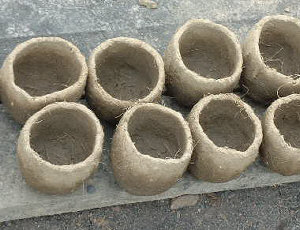
As the moulds build up fibrous material is added to the mixture to strengthen it


The Kiln


Crucibles are made that exactly fit over the finished the finished moulds


How it works is that you put the brass in here...


And it fits on top like this


Brass taps and pipes are often used


Along with brass models that didn't work out


The crucibles are all filled with brass and then joined together to the waiting mould


A trench kiln is prepared and the crucibles are put in the kiln and fired. As they get hot the wax melts and the molten brass flows in and takes its place


Cleaning and finishing


After they have baked in the kiln the crucibles are broken open to reveal the finished pieces inside


But it's not over yet... each of the pieces has to be cleaned which is a long job


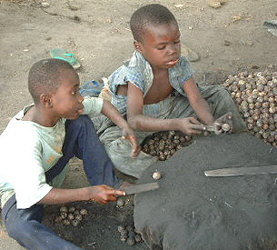
Everyone in the workshop helps out - even the children


In fact it's a family job... and this is how children start to learn the skill


This man is working on an X rated model.... something for everyone!


And here are the glorious finished pieces - all cleaned and shiny


People come from all over the world to see the skills of these artisans...


And we say good by to the artisans at the "lost wax" brass workshop in Ghana