--------------------------------------------------------------------------------------------
Blog Home Shop now! About Media Showcase Links
--------------------------------------------------------------------------------------------

Thursday, December 1, 2011

The Lost Wax Brass Process

The "lost wax" brass process is an ancient tecnique used for making brass models and sculptures. Amongst the Asante of Ghana this technique was used to mend the bones of ancestors which are considered sacred. It was also used to make the gold ornaments so beloved in West Africa. Nowadays brass is more commonly used... First a detailed model object is made completey out of bees wax. This wax mould is then hardened with ash and prepared for the kiln where recycled brass is melted and replaces the wax - which is "lost". See how it's done below.

Making the wax model

Wax from the African honey bee is used


First it's formed into the rough shape and size needed


Sometimes the wax is pressed into moulds to form the basic shape


After the basic shape has been formed...


Pieces of wax are modelled to make the decorations


Then the decoration can begin


An old syringe is used to make strings of wax


But when you need a lot production can be cranked up using innovative technology!


This is fiddly work - the fine strings of wax are shaped and fused to the base shape - it needs a steady hand and great concentration...


After the strings of wax have been applied they are sculpted - every detail made in wax will be replaced by brass


The finished wax faces - Adinkra symbol "gye nyame" moulds


Beads and hollow brass models are made from fine strings of wax built up over a charcoal mould


All done with these simple tools...


And all part of a day's work for this artisan at his workbench


Building up the wax model into a mould

Pieces of charcoal are pounded...


Into a fine powder


The powder charcoal is mixed with water...


And the wax models are dipped into the mixture


And given a thick coating...


And then left to dry and harden


Channels are left for the brass to pour in and replace the wax


Preparing the moulds for the kiln
The models are dipped again and again to build up the mould cases


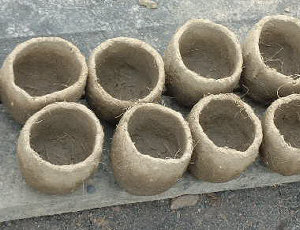
As the moulds build up fibrous material is added to the mixture to strengthen it


The Kiln


Crucibles are made that exactly fit over the finished the finished moulds


How it works is that you put the brass in here...


And it fits on top like this


Brass taps and pipes are often used


Along with brass models that didn't work out


The crucibles are all filled with brass and then joined together to the waiting mould


A trench kiln is prepared and the crucibles are put in the kiln and fired. As they get hot the wax melts and the molten brass flows in and takes its place


Cleaning and finishing


After they have baked in the kiln the crucibles are broken open to reveal the finished pieces inside


But it's not over yet... each of the pieces has to be cleaned which is a long job


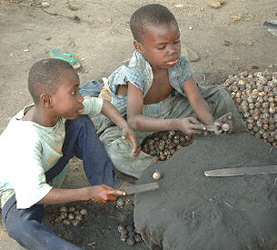
Everyone in the workshop helps out - even the children


In fact it's a family job... and this is how children start to learn the skill


This man is working on an X rated model.... something for everyone!


And here are the glorious finished pieces - all cleaned and shiny


People come from all over the world to see the skills of these artisans...


And we say good by to the artisans at the "lost wax" brass workshop in Ghana

Sunday, November 27, 2011

eShopAfrica cotton, handpainted T-shirts


Cotton T shirts, handpainted one of a kind. Cool and chic

Tuesday, November 22, 2011

Ghana launch of Ambiente 2012


Mrs Yvonne Engelmann, Director Giving of Messe Frankfurt Exhibition GmbH, has come to Ghana to promote and create awareness for the upcoming Ambiente 2012 and to acquire suitable companies from the handicraft business as exhibitors
eShopAfrica has been invited as a member of the GGEA(Ghanian-German economic Association)and as a pioneer in Ghana to show case artisans handmade products thru the internet.

Thursday, November 17, 2011

Young girls learning how to weave baskets


The art of basket weaving:- These young girls from North of Ghana are learning how to weave on weekends. eShopAfrica supported and encouraged such moves so as to keep these traditional beautiful Bolga baskets for generations to come

Thursday, November 3, 2011

Colourful African Back Packs


These cute back packs are very practicale, 100% cotton, washable, can be customized to any size, most of all affordable, Wow!!

Friday, September 2, 2011

Gallery: Textiles: Kuba and Raffia cloth

Kuba and Raffia cloth

We're sorry but we don't sell this item in our shop.  If you're a fair trade supplier please get in touch


Kuba cloth is the embroidered and appliqued fabric of the Kuba people of central Africa who leave around Kinshasa in modern day Congo. It is made from woven raffia and it's geometric art forms have been the source of inspiration for artists such as Picasso, Klee and Matisse who owned an extensive collection. For the Kubans the cloth forms an important part of their funeral rites. In order to be recognised by your ancestors when you get to the other side you must be wearing the correctly patterned cloth. These designs are handed down from generation to generation and it is the strength of this tradition that has kept the skills of making Kuba cloth alive.

To make Kuba cloth first a plain square is woven from raffia on a loom - this is usually the work of men. Kuba cloth is very stiff when first woven, so it is pounded in a mortar to soften it. This can cause holes which are a normal part of the cloth but they are sometimes covered with applique designs. After weaving and beating women - although sometimes also men - decorate the cloth using different designs, techniques and materials.

There are about 200 different designs that are known by name but each piece is unique as the artisans improvise as they work.


KUBA005: Long piece of Kuba cloth made from raffia. Complete with rust, dark and light brown and ochre. Applique and tie dyed stripes - a few holes.
24 inches wide 4 yards long

KUBA002: Kuba cloth, made from Raffia, partial, Dark rust colored border with tie dyed elements, embroidered center.
19 inches wide 41 inches long


KUBA003: Kuba cloth, made from Raffia, not complete, dark and light brown appliqué design with some cowry shells.
14 inches wide 48 inches long


KUBA004: Kuba cloth made from Raffia, not complete. Rust colored body with embroidery and cowries. Bobble border mostly complete
14 inches wide 69 inches long


KUBA001: Long piece of Kuba cloth, made from Raffia, not quite complete, has raffia bobbles on the side. Rust colored border, brown middle with cowry shells, embroidery and appliqué patches.
19.5 inches wide 3 yards long


RAFI001 : 19.5 x 28 inches


RAFI002 : 22.5 x 20 inches


RAFI003 : 21 x 26 inches edges are frayed


RAFI004 : 21 x 26 inches


 RAFI005 : 19 x 25 inches edges are frayed


RAFI006 : 22 x 23 inches


RAFI007 : 25 x 25 inches


Saturday, August 6, 2011

Empire State Building Coffin


Sarah Murray, a journalist with the Financial Times, has just published her most recent book called Making an Exit which looks at the way different cultures dignify their dead. As part of her research she ordered her own dream coffin in the shape of the Empire State Building from eShopAfrica.com. See the pictures of her coffin being made in the eShopAfrica Coffin Gallery or watch the video of her trying it out when it arrived in New York.

You can buy Ga coffins (or thematic chests which are much smaller and less spooky) in our Coffin shop.